New publication on methylotrophic methanogens in freshwater wetlands
Narrowe, A.B., Borton, M.A., Hoyt, D.W., Smith, G.J., Daly, R.A., Angle, J.C., Eder, E.K., Wong, A.R., Wolfe, R.A., Pappas, A., Bohrer, G., Miller, C.S. & Wrighton, K.C., 2019. Uncovering the Diversity and Activity of Methylotrophic Methanogens in Freshwater Wetland Soils W. Orsi, ed. mSystems, 4(6), pp.e00320-19. [link]
This study uses field work, laboratory microcosms, and multiple types of omics data to gain new insights into how methylotrophic methanogens contribute to carbon cycling in the Old Woman Creek freshwater wetlands. This is another publication stemming from our fantastic collaboration with the Wrighton Lab at CSU.
Maria presents our work at ASM 2019
Maria Nikulkova is presenting her work this week on some new Aenigmarchaeota genomes at the American Society for Microbiology annual meeting (ASM Microbe). She also was awarded the ASM Capstone Research Fellowship this year! With this award, Maria gets her travel to present her poster at the ASM Microbe meeting covered, and will participate in the ASM Microbe Academy for Professional Development. Congratulations, Maria!
New publication utilizing metagenomic data for understanding the evolution of translation
This is the product of a great collaboration with some excellent labs and people.
Diphthamide is a modified histidine residue which is uniquely present in archaeal and eukaryotic elongation factor 2 (EF-2), an essential GTPase responsible for catalyzing the coordinated translocation of tRNA and mRNA through the ribosome. In part due to the role of diphthamide in maintaining translational fidelity, it was previously assumed that diphthamide biosynthesis genes (dph) are conserved across all eukaryotes and archaea. Here, comparative analysis of new and existing genomes reveals that some archaea (i.e., members of the Asgard superphylum, Geoarchaea, and Korarchaeota) and eukaryotes (i.e., parabasalids) lack dph. In addition, while EF-2 was thought to exist as a single copy in archaea, many of these dph-lacking archaeal genomes encode a second EF-2 paralog missing key-residues required for diphthamide modification and for normal translocase function, perhaps suggesting functional divergence linked to loss of diphthamide biosynthesis. Interestingly, some Heimdallarchaeota previously suggested to be most closely related to the eukaryotic ancestor maintain dph genes and a single gene encoding canonical EF-2. Our findings reveal that the ability to produce diphthamide, once thought to be a universal feature in archaea and eukaryotes, has been lost multiple times during evolution, and suggest that anticipated compensatory mechanisms evolved independently.
Graduation 2018
The lab feels like it’s emptying out, with 1 PhD, 1 MS, and 2 BS graduates this May. Congratulations to: Dr. Adrienne Narrowe, PhD (with both the College of Liberal Arts and Sciences and the Department of Integrative Biology outstanding Defense awards) David Banks-Richardson, MS Biology Maria Nikulkova, BS Biology Connor Jacobs, BS Biology
A great accomplishment for each of them, and the whole lab can’t wait to see what each accomplishes next.
New freshwater wetlands / methane publication
Our Old Woman Creek Wetlands team has a new publication out revealing that much of the methane in this wetland appears to come from a novel methanogen residing in surface, oxygenated soils. Congratulations and thanks to the Wrighton and Bohrer labs, who led this work.
Angle, J.C., Morin, T.H., Solden, L.M., Narrowe, A.B., Smith, G.J., Borton, M.A., Rey-Sanchez, C., Daly, R.A., Mirfenderesgi, G., Hoyt, D.W., Riley, W.J., Miller, C.S., Bohrer, G. & Wrighton, K.C., 2017. Methanogenesis in oxygenated soils is a substantial fraction of wetland methane emissions. Nature Communications, 8(1), p.1567.
Congratulations, Mallika
Congratulations to Mallika, who successfully defended her MS Thesis, “Prediction of Prokaryotic Optimum Growth Temperature Based on Genomic And Proteomic Features.” Mallika did a great job, showing her mastery of her research and the literature.
Mallika is off to the Burnham Institute to pursue her PhD with Adam Godzik.
And the award goes to…
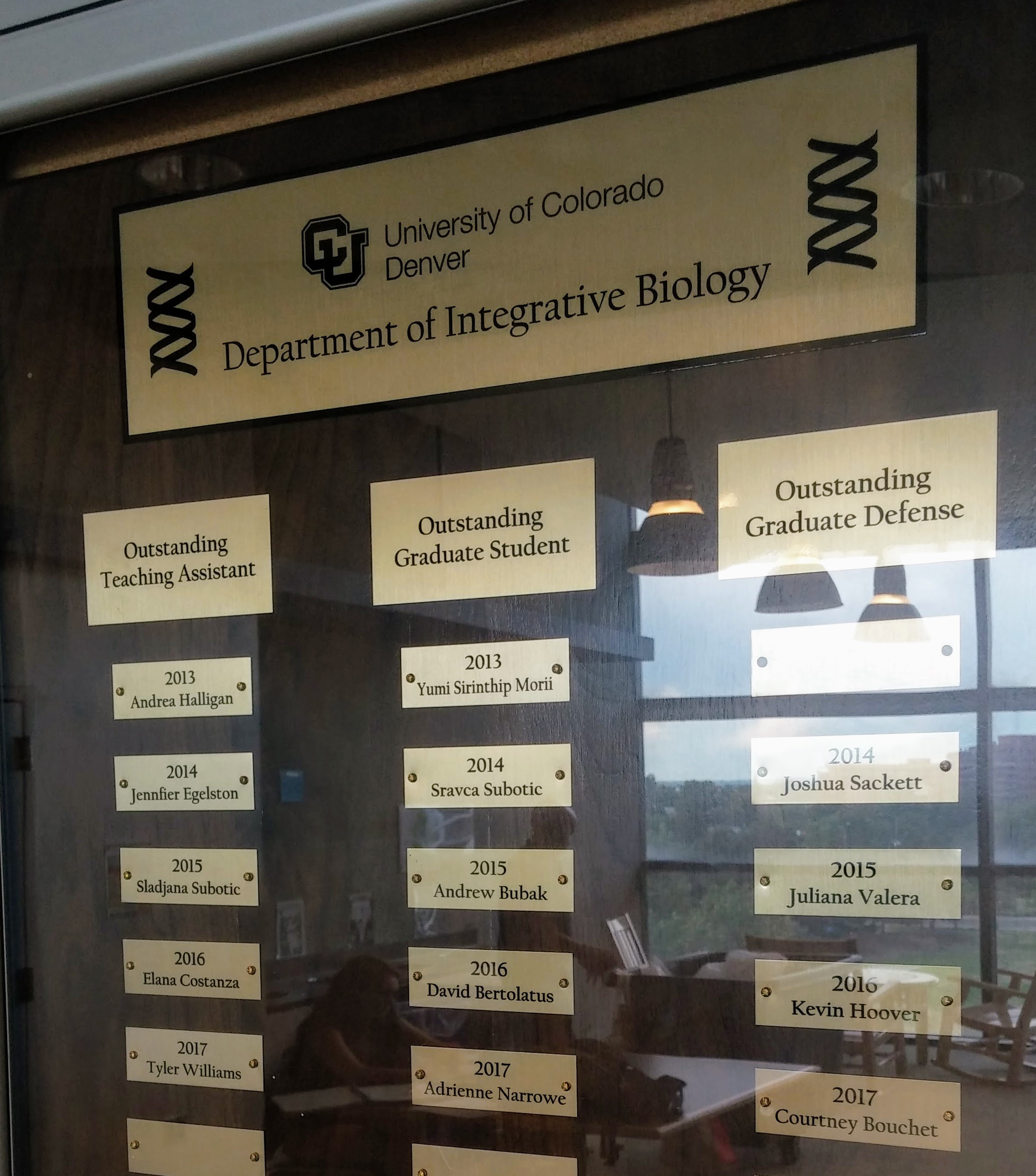
2017 Integrative Biology Outstanding Graduate Student of the Year: Adrienne Narrowe!
Congratulations, Adrienne.
Kendra DeHay, MS
Congratualtions to Master of Science Kendra DeHay, graduating from the Master’s Program in Biomedical Sciences & Biotechnology!
PhD-Bound
Congratulations to Mallika and to Nihal! Both are headed to do great things in great PhD programs. Mallika will be joining Adam Godzik’s group at the Sanford Burnham Prebys Medical Discovery Institute, and Nihal is joining the UC Irvine Interdepartmental Neuroscience Program. Each program is lucky to have an exceptional student.