New Publication on evaluating computational methods to infer protein function
We have a new paper out that performs a detailed comparison of computational methods for inferring enzyme function. This is collaborative work with Saeedeh Davoudi and Farnoush Banaei-Kashani in Computer Science at CU Denver, and also involved Chris Henry at Argonne National Lab. There are so many methods out there to do these kinds of predictions of function, but little bioinformatics research that explores how to objectively evaluate the methods. Read more in our Bioinformatics Advances paper here: EC-Bench: a benchmark for enzyme commission number prediction.
New Publication on 1,4-dioxane bioremediation at the Lowry Landfill
The Lowry Landfill is an EPA Superfund site that operates a very unique microbial solution for cleaning up contaminated groundwater. The Biological Treatment System uses natural microbes to degrade 1,4-dioxane, and is a system that is pretty much unique in the US. Thanks in large part to the hard work of Jessie Romero, MS, we have a new publication out that gets us closer to a mechanistic understanding of how the system works, thanks to shotgun metagenomics and marker gene sequencing. In addition to data generated and analyzed by Jessie and the rest of the co-authors, this work also includes data generated by our first year General Biology students here at CU Denver! Read more here: Community and functional stability in a working bioreactor degrading 1,4-dioxane at the Lowry Landfill Superfund Site.
Derick Singleton, MS
Congratulations to Derick, who defended his MS Thesis. Derick used the GROW river microbiome dataset to explore the distribution of antimicrobial resistance genes in US rivers. He was also a co-author on the Nature paper describing these U.S. river microbial communities. Congratulations, Derick!
Alyssa wins 2 undergraduate awards before starting PhD program
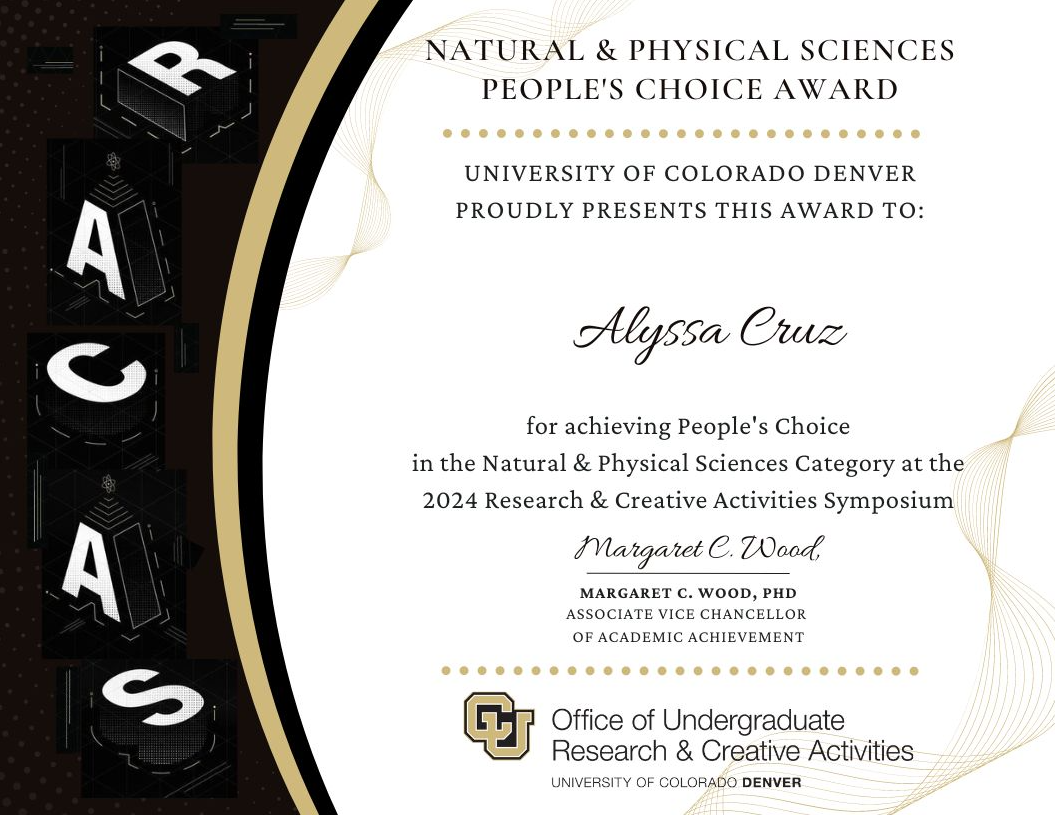
Alyssa Cruz, an outstanding undergraduate researcher in the lab, has won the… Outstanding Undergraduate in Public Health Award, and won a poster award at the 2024 CU Denver Research and Creative Activities symposium. After graduation this semester, she’s headed off to do a PhD at the Sanford Burnham Prebys Medical Discovery Institute. Congratulations, Alyssa!
Jessie wins poster award at FRMS
Congratulations to our collaborator Jessie Romero here at CU Denver, who won a poster award at this year’s Front Range Microbiome Symposium (FRMS) for her work on uncovering potential 1,4-dioxane mechanisms in a local bioremediation facility. Jessie’s use of shotgun metagenomics to uncover unique candidate degradation enzymes is a great demonstration of detailed hypothesis generation from high-throughput sequencing technology.
Congratulations Lucia for her MS Defense
Congratulations to Lucia, who defended her MS Thesis today. Lucia’s thesis advanced our ability to predict and annotate plasmid contigs from environmental samples with metagonmic sequencing, and highlighted the strengths and limitations of current tools. Congratulations, Lucia!
New science education publication
Chris contributed to a new publication led by Joslynn Lee at Ft. Lewis College that describes “a curriculum and research framework designed to integrate an Indigenous approach when conducting authentic scientific research and to build interest and confidence at the undergraduate level.” Monitoring environmental microbiomes: Alignment of microbiology and computational biology competencies within a culturally integrated curriculum and research framework is published in Molecular Ecology Resources. Read this important work here. Some of the lessons we learned in this project have informed our Biology curriculum here at CU Denver.
Jessie Romero defends MS thesis on 1,4-dioxane degradation
We are all celebrating Jessie Romero, a collaborator from the Roane lab, for defending her MS Thesis, “Using Metagenomic Sequencing to Elucidate the Bacterial Degradation of 1,4-Dioxane in Groundwater Associated With a Colorado Landfill.” Jessie used metagenomic sequencing to identify several candidate organisms and proteins involved in 1,4-Dioxane degradation. Her work has opened up a whole new area of research for the lab and our collaborators in the Roane lab to pursue. Jessie also is the College of Liberal Arts and Sciences Outstanding MS graduate this semester. Congratulations, Jessie!
Congratulations Alex on a successful MS Thesis Defense
Congratulations to Alex Romero for a great MS Thesis defense. Alex’s thesis was titled, “Characterizing the Gut Microbiome of Golden Retrievers Using Highly Replicated 16s rRNA Sequencing.” Alex did a great job managing a complex project with many challenges, including hurdles brought on by the pandemic. Congratulations, Alex!